Price Action Overview:
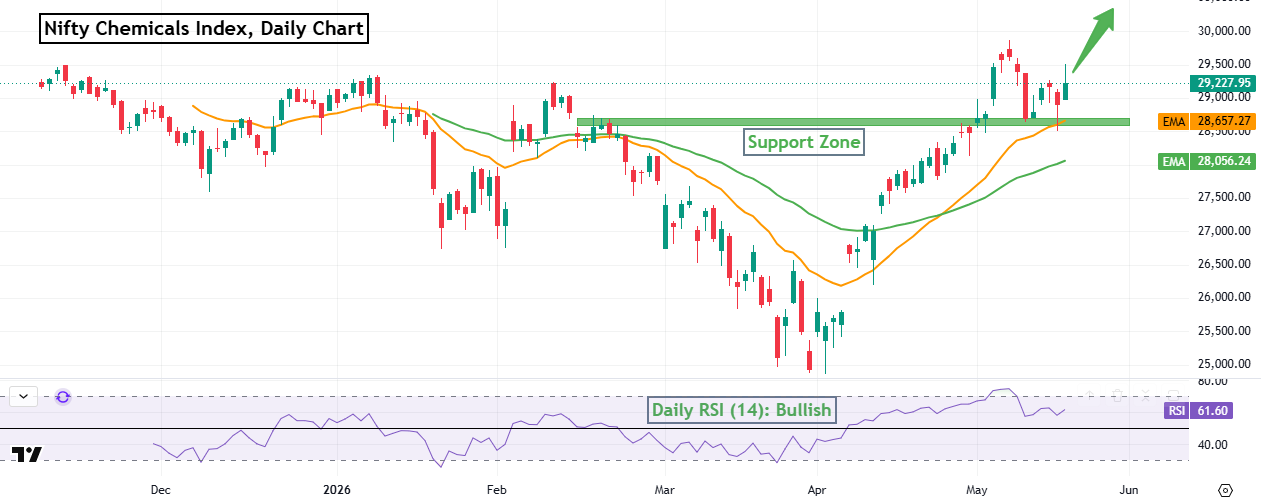
The Nifty Chemicals Index staged a strong rebound in April 2026 amid improving global sentiment following the ceasefire announcement during the ongoing West Asia conflict, although no formal agreement has been signed so far. The index significantly outperformed the broader market, rebounding 14.21% in April 2026 compared to Nifty’s 7.46% recovery, reflecting strong sectoral momentum and renewed buying interest. Despite lingering geopolitical tensions in West Asia, the Chemicals Index has managed to sustain most of its gains and continues to remain in a clear uptrend on the daily timeframe.
Technically, the index witnessed mild profit booking near the 29,900 zone following its all-time high breakout, but it successfully held the crucial support region around 28,600 and found support near the 20-day EMA (28,657), indicating a healthy retracement. The index also continues to trade comfortably above the 50-day EMA placed near 28,056, reflecting sustained medium-term strength. The daily RSI (14) stands at 61.6 and remains above the neutral 50 mark, signalling continued bullish momentum despite short-term consolidation. Sustaining above the 28,600 support zone could lead to a retest of the recent swing high near 29,900, and potentially a move above the psychological 30,000 mark in the coming months.
Trend Analysis:
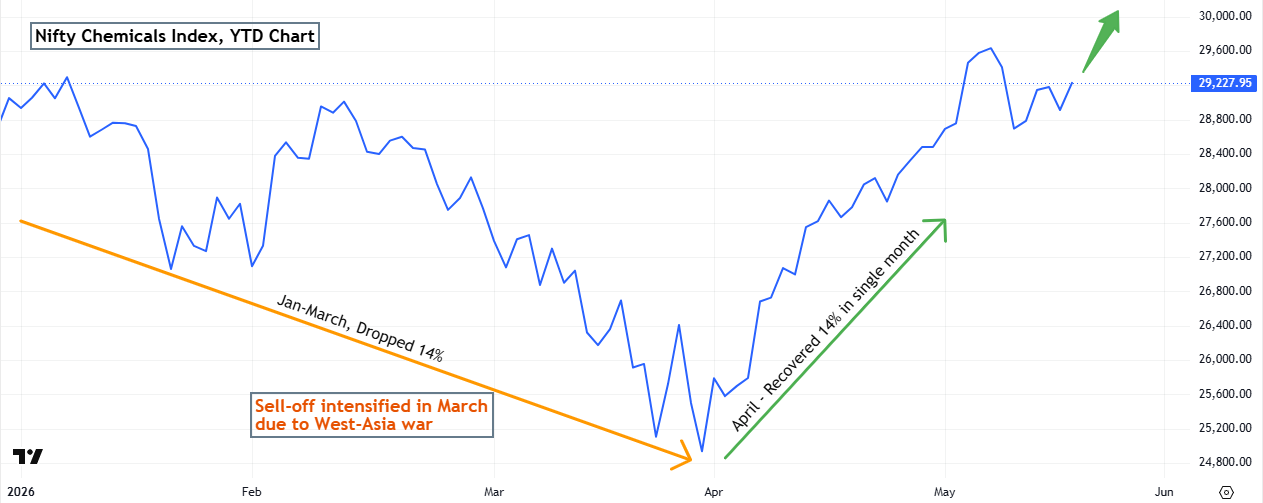
From January to March 2026, the Nifty Chemicals Index corrected nearly 14% amid escalating West Asia tensions, rising crude oil prices and weak global chemical demand. However, sentiment reversed sharply in April after the ceasefire announcement, despite no formal agreement being signed. The index staged a powerful V-shaped recovery, reclaiming the entire three-month decline within a single month and breaking above its previous all-time high. Despite Brent crude closing near $109 per barrel and the Rupee hitting a record low of ₹96.5 against the US dollar, the index continues to show strength with a clear higher high & higher low structure, signalling the broader uptrend remains intact.
Industry Analysis:
India’s chemical industry continues to show strong long-term growth potential driven by rising domestic demand, policy support and increasing investments. India is currently the sixth-largest chemical producer globally and third in Asia, contributing nearly 7% to the country’s GDP. According to McKinsey, India’s chemicals and petrochemicals demand could nearly triple to USD 1 trillion by 2040. Export momentum also remains strong, with shipments touching USD 9.19 billion during FY26 (April–June). Government initiatives such as the PLI scheme and PCPIR projects are boosting investments and infrastructure development. Meanwhile, growing opportunities in specialty chemicals, green solvents and biodegradable products are positioning India as a key alternative to China in global supply chains.
Leading Picks in the Chemicals Space:
- CHEMICAL – Kotak Nifty Chemicals ETF.
- SOLARINDS.
- PIDILITIND.
Conclusion:
The Nifty Chemicals Index continues to exhibit strong relative strength after a sharp V-shaped recovery from the March lows, signalling continuation of the broader uptrend. The index has recovered its entire three-month decline, while holding above the 20-day EMA, keeping the bullish structure intact. A breakout above 29,900 could trigger a rally beyond the psychological 30,000 mark. However, rising West Asia tensions, elevated crude prices, and Rupee weakness remain key risks for the sector.
Key supports: 28,600 / 28,000 / 27,350.
Disclaimer: Investments in the securities market are subject to market risks, read all related documents carefully before investing. Securities quoted here are exemplary, not recommendatory. Please consult your financial advisor before investing. Please note that we do not guarantee any assured returns for the securities quoted here.
Research disclaimer: Investment in the securities market is subject to market risks. Read all the related documents carefully before investing. Registration granted by SEBI, and certification from NISM in no way guarantee the performance of the intermediary or provide any assurance of returns to investors.
For more details, please read the disclaimer.