Kajaria Ceramics Ltd. – India’s No.1 Tile Company
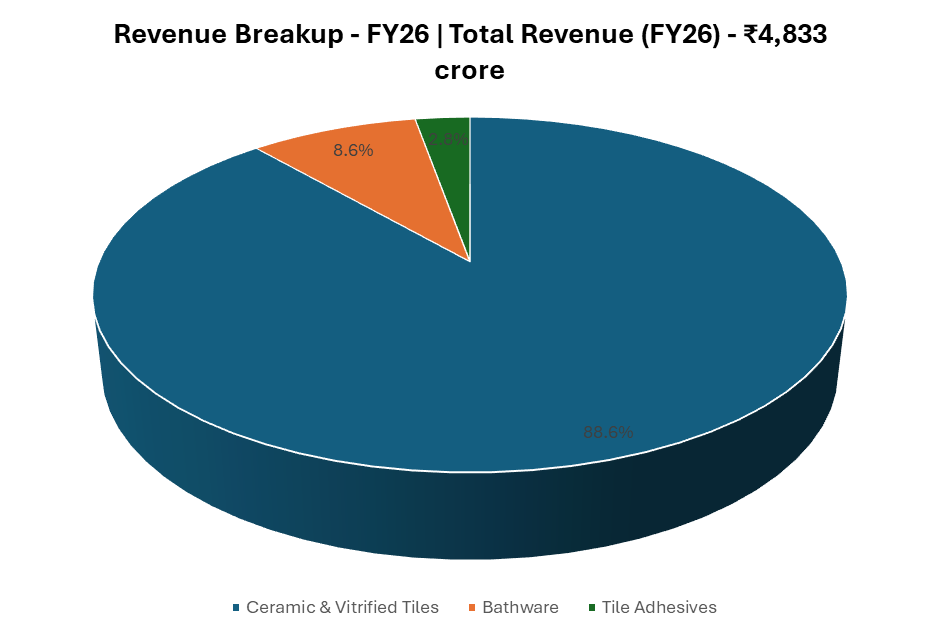
Kajaria Ceramics Limited, incorporated in 1985 and headquartered in Gurugram, is India’s largest manufacturer of ceramic and vitrified tiles and the eighth largest globally. The business falls within a single reportable segment, tiles, spanning ceramic wall and floor tiles, polished vitrified tiles and glazed vitrified tiles, alongside a bathware and adhesives portfolio reported under others, which covers sanitaryware and faucets sold under the Kajaria and Kerovit brands. Installed tile capacity stands at 82.70 MSM per annum across eight plants – Gailpur (35.95 MSM) and Malootana (6.50 MSM) in Rajasthan, three units at Morbi in Gujarat (17.90 MSM combined), Sikandrabad in Uttar Pradesh (8.80 MSM), Srikalahasti in Andhra Pradesh (8.80 MSM) and Balanagar in Telangana (4.75 MSM) – excluding a further 5.10 MSM at Kajaria Ramesh Tiles, its 50% Nepal joint venture. Bathware capacity comprises 12 lac pieces per annum of sanitaryware across two Morbi units and 1.60 million pieces per annum of faucets at Gailpur, while tile adhesive capacity of 9,000 MT per month each is operational at Gailpur and, since May 2026, at Erode in Tamil Nadu.
Products and Services
The company’s main products include tiles, faucets, sanitaryware and tile adhesives.
Subsidiaries: As of FY26, the company has 10 subsidiaries and 3 joint ventures.
Investment Rationale
- Capacity expansion to drive growth and improve cost efficiency – Kajaria is stepping up capex to support double-digit volume growth, with ₹400 crore capex planned for FY27. Key projects include the ₹210 crore Srikalahasti expansion and ₹165 crore Bhiwadi expansion, with commissioning expected during FY27/early FY28. The company has also approved 11 MSM of additional capacity at Gailpur, driven by rising demand from the North and East, while a 10 MSM high-value product line at Srikalahasti is being commissioned. The new capacities will improve product mix, incorporate newer technology and lower production costs, making them high-ROCE accretive. With existing tile capacity of 82.7 MSM, these investments provide significant capacity headroom and are expected to support sustained volume growth, better margins and improved capital efficiency.
- Margin expansion aided by gas-price-led industry consolidation – Sharp increase in Morbi gas prices is strengthening organised players’ competitive position: Gas prices in Morbi have increased sharply from around ₹47 – 48/SCM to ₹86 – 88/SCM, resulting in a significantly higher cost burden for Morbi-based manufacturers. Consequently, Morbi players have had to raise tile prices by ~40 – 45%, compared with only ~10 – 11% price increases at Kajaria’s North and South plants, substantially narrowing the historical price gap with the unorganised market. The sharp rise in input costs, coupled with greater pricing discipline, is likely to accelerate consolidation in the tile industry, as smaller/unorganised Morbi manufacturers face pressure on viability and competitiveness. YoY average ROE has improved from 15.57% to 21.51% and ROCE has improved from 20.3% to 28.08%. This provides organised players such as Kajaria with an opportunity to gain market share while supporting sustained margin expansion through better pricing, product mix and cost optimisation.
- Q1FY27 – On a consolidated basis, Kajaria reported revenue from operations of ₹1,328.08 crore in Q1FY27, up 20.4% YoY from ₹1,102.74 crore in Q1FY26. Volume growth of 6% YoY was held back by a very weak April, and the bulk of the revenue increase was driven by price increases rather than volume. EBITDA rose 41.0% YoY to ₹260.33 crore with margin expanding ~288 bps to 19.60% from 16.72%, and profit after tax attributable to owners grew 55.5% to ₹169.46 crore from ₹108.98 crore, helped by flat depreciation of ₹42.24 crore and finance costs of ₹5.00 crore. Growth was broader than tiles alone: tile segment revenue rose 17.5% to ₹1,159.40 crore and segment result to ₹197.42 crore, while the others segment – bathware, sanitaryware and adhesives – rose 44.9% to ₹168.68 crore with segment result at ₹20.72 crore. Net cash improved to ₹985 crore at June 2026 from ₹793 crore at March 2026 (net debt to equity of -0.30x) and working capital days reduced to 46 from 59 a year earlier.
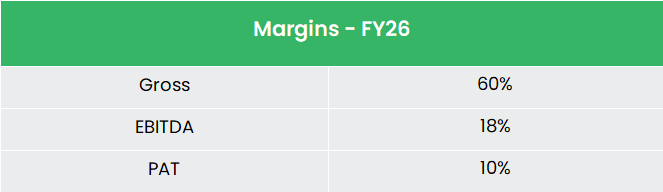
- FY26 – During FY26, consolidated total sales grew 3% YoY to ₹4,832.50 crore from ₹4,683.24 crore, on tile sales volumes of 118.52 MSM (up 3% from 114.69 MSM) even as own production fell 4% to 84.59 MSM; revenue from continuing operations, excluding the discontinued plywood business, was ₹4,830.36 crore. Profitability improved well ahead of the topline: EBITDA rose 44.3% to ₹861.95 crore with margin expanding ~508 bps to 17.84% from 12.76%, and profit before share of JV profit, exceptional items and tax rose 60.7% to ₹722.78 crore. Profit after tax attributable to owners increased 64.9% to ₹485.41 crore from ₹294.36 crore, after an exceptional loss of ₹44.02 crore against ₹14.50 crore in FY25. The recovery was progressive through the year, with quarterly EBITDA margin rising from 16.72% in Q1FY26 to 19.19% by Q4FY26.
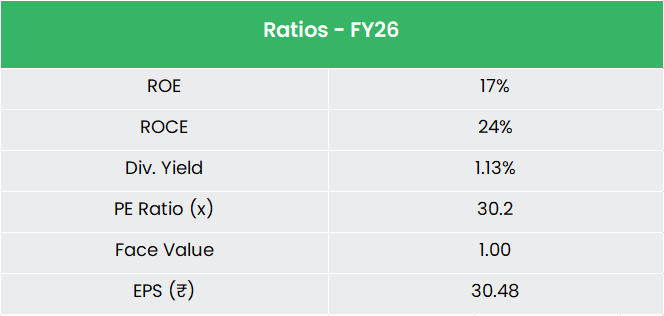
- Financial Performance – The 3-year revenue and net profit CAGR stand at around 3% and 14% respectively, the topline reflecting a weak tile-demand cycle while earnings recovered on margin expansion. The company is effectively debt-free, holding net cash of ₹985 crore at June 2026 against borrowings of ₹229 crore at March 2026. The 3-year average ROE and ROCE are around 15% and 20% respectively for the FY23-26 period, improving to 18% and 23% in FY26, and cash generation is strong, with FY26 operating cash flow of ₹664 crore and free cash flow of ₹563 crore.
Industry
India’s real estate sector, the principal demand driver for tiles, bathware and building materials, contributed nearly 7.30% to GDP as of November 2025 and remained the country’s second-largest employment generator. The market was valued at ₹54.96 lakh crore (US$ 650 billion) in 2025 and is projected to reach ₹553.38 lakh crore (US$ 5.80 trillion) by 2047, with the residential segment alone expected to deliver new homes worth ₹86.44 lakh crore (US$ 906 billion) by 2034 and housing demand reaching 93 million units by 2036. In H1 2026, India’s eight largest residential markets recorded 171,471 home sales against 187,350 launches, while FY25 saw approximately 406,889 homes delivered across the top nine cities, a 33% increase over 306,600 units in FY24. Construction remains among the largest FDI recipients, attracting ₹2,81,161.95 crore (US$ 38.74 billion) in construction activities and ₹1,39,475.21 crore (US$ 27.55 billion) in construction development between January 2000 and March 2026. Within building materials, the domestic tile industry remained subdued through much of FY26 on pricing pressure from the unorganised sector, though industry volumes are expected to contract in the current year even as value grows, as share shifts towards branded manufacturers.
Growth Drivers
- Urbanisation and Premiumisation of Housing: India’s urban population is projected to rise from 522.4 million in 2025 to 607.3 million by 2030, with the World Bank estimating 600 million urban residents by 2036, or roughly 40% of the population. Premium housing now leads the cycle, with homes priced above ₹1 crore accounting for 71% of residential sales in Q1 2026 against 59% a year earlier, and launches in that segment up 45% YoY, lifting per-unit consumption of higher-realisation vitrified and large-format surfaces.
- Government Capex, Affordable Housing and GST 2.0: Public capital expenditure has been raised 11.5% to ₹12.22 lakh crore (US$ 138.3 billion) in FY27, while the Ministry of Housing and Urban Affairs allocation rose 50% to ₹85,522 crore (US$ 9.68 billion). Any construction sector investment impacts 275 linked building materials, components and machinery industries. GST 2.0 is expected to reduce construction costs by 3.5 – 4.5% and housing prices by 5 – 8%, while the RBI’s December 2025 repo cut to 5.25% further supports affordability.
- Formalisation and Export Corridors: Sharply higher gas prices have forced widespread shutdowns and the Morbi cluster’s first significant price hikes, compressing unbranded supply and narrowing the price gap against national brands; as that gap compresses, preference is expected to shift decisively towards branded products. Globally, the phased withdrawal of Chinese export subsidies and India’s widening FTA network are opening new export corridors, with rising export volumes drawing down domestic inventory.
Peer Analysis
Competitors: Somany Ceramics Ltd, Cera Sanitaryware Ltd, etc.
Kajaria is the largest company in the peer set and the only one operating tile capacity at scale through wholly and majority-owned plants. That scale shows up in profitability: Kajaria’s Q1FY27 consolidated EBITDA margin of 19.6% compares with roughly 12% for Somany and 10% for Cera, and it boasts the best return profile in the peer set. The balance sheet reinforces the gap – Kajaria held net cash of ₹985 crore at June 2026, whereas Somany’s ₹374 crore of borrowings at March 2026 absorb around ₹46 crore of annual interest against trailing operating profit of about ₹296 crore, the principal reason its return ratios screen lowest.

Outlook
Kajaria is well positioned to benefit from the ongoing shift towards organised tile manufacturers, as sharply higher natural gas prices in Morbi have narrowed the price differential between Kajaria and Morbi products to below 20% from ~40% earlier. This improves the competitiveness of branded tiles and could drive market-share gains as smaller unorganised players face pressure on costs and profitability. The company is strengthening its distribution network and expanding its project business, while its planned capacity additions at Srikalahasti and Gailpur will support higher volumes and improve cost efficiency. Management has guided for double-digit volume growth over the next nine months of FY27 and expects 18 – 19% EBITDA margins and ₹1,000 crore+ operating EBITDA for FY27. With ~₹400 crore of FY27 capex and improving product mix, Kajaria is positioned for sustained volume growth, margin expansion and stronger return ratios.
Valuations
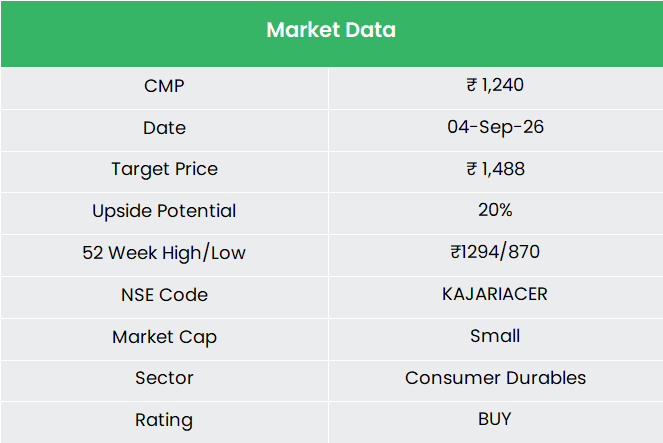
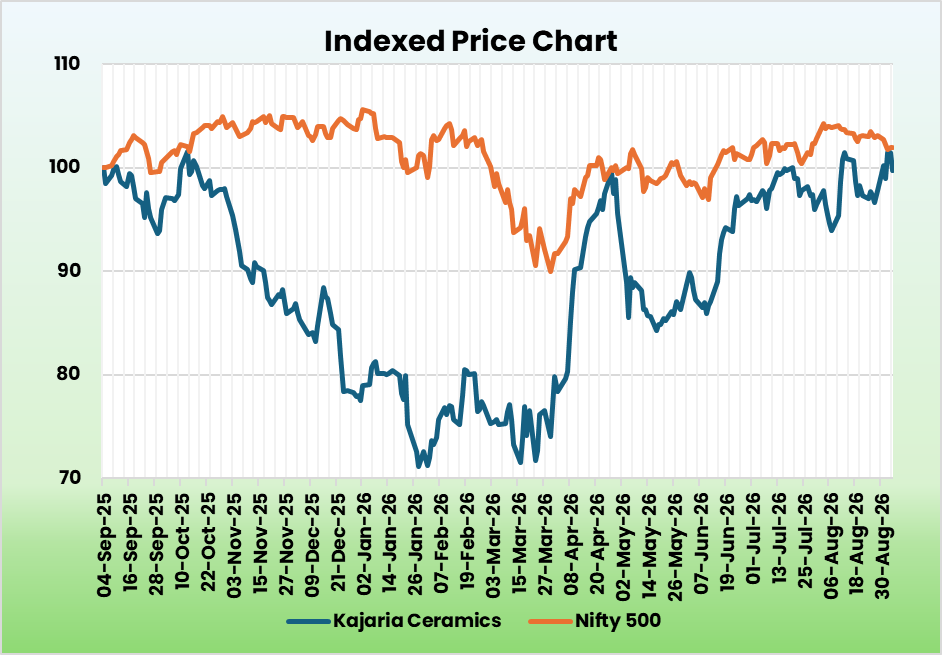
Given its position as the largest organised player in the tiles industry and sustained demand tailwinds, we expect Kajaria Ceramics Ltd to retain its market leadership. We recommend a BUY rating in the stock with the target price (TP) of ₹1,488, 38x FY28E EPS. We also encourage maintaining a stop-loss at 20% from the entry price to manage potential downside risk effectively.
SWOT Analysis
| Strength | Weakness |
|
|
| Opportunities | Threats |
|
|

Disclaimer: Investments in the securities market are subject to market risks, read all related documents carefully before investing. Securities quoted here are exemplary, not recommendatory. Please consult your financial advisor before investing. Please note that we do not guarantee any assured returns for the securities quoted here.
Research disclaimer: Investment in the securities market is subject to market risks. Read all the related documents carefully before investing. Registration granted by SEBI, and certification from NISM in no way guarantee the performance of the intermediary or provide any assurance of returns to investors.
For more details, please read the disclaimer.